

What Is The Makeup Of The Protesters Against The Keystone Pipeline
When President Biden rescinded a crucial permit for the Keystone XL pipeline last week, it marked the culmination of 1 of the longest, highest-contour campaigns in the North American climate move. The opposition to Keystone Xl included large environmental organizations, grassroots climate activist networks, Nebraska farmers, Texas landowners, Indigenous rights groups and tribal governments. Few ecology campaigns have touched so many people over such large swaths of the continent.
The Keystone XL resistance was part of the ongoing opposition to the Canadian tar sands, one of the most carbon-intensive industrial projects on the planet. Yet, information technology came to symbolize something even bigger. Many activists saw stopping Keystone 40 equally a measure out of success for the climate motion itself.
"Keystone XL isn't just whatever project," said longtime activist Matt Leonard, who coordinated several major protests against the pipeline. "Its defeat is a attestation to what motion edifice and direct action can reach."
A stroke of President Biden's pen finally killed Keystone Twoscore. But paving the way for this victory were countless battles at the grassroots level, where activists tested new tactics and organizing strategies that congenital a bolder, savvier climate movement. Some of the groups involved took radically different approaches to politics, leading to unexpected alliances and occasional bitter feuds. And in that location were losses — other major oil pipelines, including the southern leg of Keystone XL itself, were completed even every bit the fight over the more famous northern half dragged on.
Even so, resistance to the Keystone XL'southward northern leg succeeded confronting overwhelming odds. While there is always a possibility information technology could be resurrected anytime, chances of that happening someday presently seem slim. Understanding how this victory happened — and what it means for the climate motion — requires examining how 10-plus years of tar sands resistance played out in far-flung parts of North America.
The frontlines of tar sands extraction
If the international movement confronting the tar sands has a birthplace, it is probably Minnesota — specifically, at the 2006 Protecting Mother World Height, which was organized by the Ethnic Environmental Network, or IEN. There, three women from the Deranger association of the Athabasca Chipewyan First Nation in Alberta approached IEN staff with a story about something horrific happening in their community.
"They told usa about a projection so big, so devastating that y'all had to see information technology to believe information technology," IEN organizer Clayton Thomas-Muller wrote in a reflection. "They spoke of a wild west of sorts, one of the last bastions of Earth where big oil was ramping up."
Over the next few years, dozens of groups on both sides of the U.S.-Canada border joined the fight that began with Indigenous organizers in Alberta.
Fort Chipewyan's mostly Indigenous population had watched in dismay as oil companies began mining a depression-quality course of petroleum known as bitumen from the Athabasca tar sands deposit in their backyard. The operation required razing former-growth woods to reach the dirt and sand underneath, so using toxic chemicals to separate the petroleum. Tar sands extraction consumes iii-iv barrels of water to produce a barrel of crude with a carbon footprint fifteen percent higher than conventional oil. Lakes of leftover toxic mine tailings were leaking into local water supplies, causing cancer clusters in downstream villages.
The industry'due south base of operations was to the southward, in Fort McMurray, a boondocks of 35,000 whose population more doubled as workers streamed in to take advantage of temporary jobs. Oil field "man camps" became hotbeds for man sex trafficking, especially of Indigenous women. The situation was already dire when the Deranger women came to IEN seeking help.
IEN had a long history opposing extractive industries on Indigenous lands, and worked with Fort Chipewyan locals to develop a campaign against the tar sands centered around pressuring governments and financial institutions. Meanwhile, U.Southward. and Canadian ecology groups were waking upwards to what was happening. The tar sands fabricated a mockery of Canada'due south climate goals while threatening to inundation the United States with exceptionally dirty oil sent through a network of new pipelines.
Over the next few years, dozens of groups on both sides of the border joined the fight that began with Indigenous organizers in Alberta. Along the way, the campaign to stop the tar sands helped reinvigorate a climate movement that had accustomed defeat for besides long.
Tar Sands Activeness
The tar sands industry's expansion plans hinged on edifice a series of major pipelines to achieve U.Due south. consumers. One, the Keystone pipeline, non to be confused with Keystone Twoscore, won approval from the George W. Bush-league administration in 2008. Activists had footling hazard of stopping that project nether an oil-friendly president merely they hoped things would change when Barack Obama took role the following year.
What else could they practise to make the protests go abroad, the Obama administration wanted to know? Cypher, the activists responded. They wanted Keystone XL stopped.
The tar sands presented Obama with one of his first major climate tests — and the administration failed. Pipelines that cross the U.S.-Canadian edge crave a special allow issued past the State Department and approval by the president. In 2009, Obama and Secretary of State Hillary Clinton granted the permit for Enbridge's Clipper tar sands pipeline, despite lobbying from environmental groups. The adjacent major tar sands conduit was up for approval in 2011. Proposed by TransCanada (at present TC Energy) to complement its older Keystone pipeline, Keystone XL would conduct upward to 800,000 barrels of oil per solar day from Alberta to the Gulf Coast. Absent-minded some dramatic new strength in politics, Keystone Xl would nearly certainly be built.
The ecology movement had walked away from such daunting conflicts before. But climate groups had been looking for an opportunity to push Obama for bolder activity. In June 2011, prominent voices including 350.org's Bill McKibben, author Naomi Klein and Tom Goldtooth of IEN published an open invitation to a multiday protest intended to change the dynamics of the Keystone XL fight. Every day for two weeks, a few dozen to a couple hundred people would sit in front of the White House until they were arrested. Each twenty-four hours, a new group would be led abroad past constabulary. The protest was calculated to make Obama finally deed decisively on climate alter by withholding Keystone Xl's allow — something he could do without help from Congress.
"Yous don't often observe perfect fights like that," said Jamie Henn of 350.org, the grouping who spearheaded the Tar Sands Action. "Striking on that specific ask of Obama, to show climate leadership past rejecting a pipeline he had full say-so over, was a breakthrough for usa."
People began signing up online. On the get-go day of the Tar Sands Action, 70 protesters including McKibben marched to the White Business firm and saturday effectually a banner reading, "Climate Modify is Non in Our National Involvement: Stop the Keystone XL Tar Sands Pipeline."
The grouping predictable they would be arrested, then brought to the police force station and allowed to post bail. Instead, they were taken to jail and kept for two nights. "People protest at the White House all the time," said Leonard, whom 350.org recruited to exist the atomic number 82 organizer for the Tar Sands Activity. "But dozens of new people getting arrested every day — the police weren't used to that. So they tried to deter the states."
Leonard and other organizers wondered what came next. Could the action continue, or would future waves of protesters be dissuaded? "The only thing we need is more than company," McKibben bodacious them when they placed a call to the jail. The protest went on.
Over the adjacent couple days, the police force gave upwards their strategy of intimidation as new waves of protesters arrived. "They released everyone after realizing we were going to alluvion their jails," Leonard said. Soon, organizers were getting calls from the White House request them to finish.
At a face-to-face meeting with McKibben, Henn, and other activists, Obama'south team explained information technology was politically impractical to deny a major pipeline let. What else could they do to make the protests go away, they wanted to know? Nil, the activists responded. They wanted Keystone XL stopped.
Previous Coverage
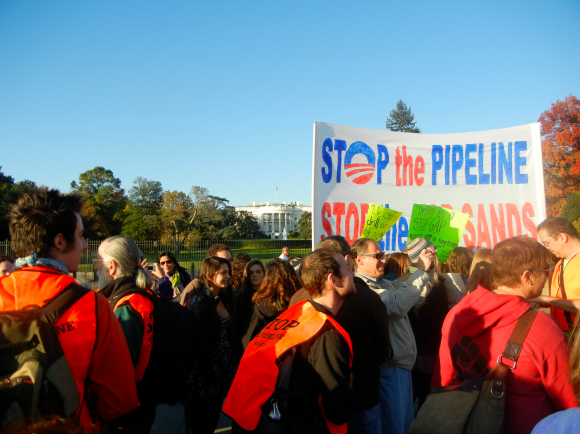 Entirely surrounded: Protesters encircle White House, close in on tar sands industry
"The Tar Sands Activeness was but l or so people getting arrested at the White House each day," Henn said. "This wasn't the revolution. Nevertheless we fabricated Obama feel really pressured. Nosotros realized nosotros needed to practice this sort of thing more than oftentimes." By the end of the ii weeks, 1,252 people had been arrested in what was then the U.S. climate motility's largest act of civil disobedience. Obama pushed back the decision on Keystone XL'due south cross-border allow to an indefinite future appointment. Perhaps the administration hoped protests would fade with time.
Meanwhile, Obama made one of his famous compromises: While continuing to review the section of Keystone XL that crossed into Canada, he would fast-rail the southern leg between Cushing, Oklahoma and the Gulf Declension. Construction on this department began the post-obit year.
In the forest of North Texas
One warm October day in 2012, Texan Maggie Gorry sat atop a 40-foot pole in the path of tractors clearing a path for Keystone XL. Other activists watched from platforms in nearby trees. The pipeline had encountered a human roadblock. It all started when a grouping of University of N Texas friends returned from the Tar Sands Action and began talking with local landowner David Daniel.
Daniel was one of many farmers and landowners along Keystone XL'due south road whose land was to be condemned through eminent domain for the pipeline. He served as an official spokesperson for the Tar Sands Action. But when Obama allowed the southern leg of Keystone 40 to get alee, most large climate groups turned to the more than winnable fight against the northern one-half. To some Texas activists, information technology felt like expose.
"Keystone XL was one project that ran all the style to the Gulf Declension," said Cindy Spoon, a UNT pupil arrested on the second twenty-four hours of the Tar Sands Activity. "But that became inconvenient for national groups and they stopped talking about it that way."
Previous Coverage
 Don't mess with Texas' Tar Sands Occludent
Daniel had vowed to build a treehouse in the pipeline's path, if necessary, to block construction on his land. Spoon and other UNT students offered to help. They drove out to Daniel's property on weekends to build wooden platforms. Slowly, the idea of involving big numbers of people in a sustained protest called the Tar Sands Blockade took shape.
The "treehouse" expanded to multiple connected platforms high above the ground. "It was more like a tree village," Spoon said. When TC Energy'south bulldozers arrived in September 2012, a group of activists ascended into the canopy. Protesters were prepared to block tree-felling equipment with their bodies, sometimes at not bad personal run a risk.
On one occasion, pipeline workers cut multiple trees fastened to ropes supporting a construction on Daniel's holding where four activists sat high off the ground. In another incident, captured on video, an earthmover ripped a large tree from the earth as activist J.G. Genson approached to force it to stop working. Footage showed the operator repeatedly swing the tree toward and away from Genson, who sat downward to show he didn't intend to move. "It felt similar he was aiming a loaded gun at me and would pull the trigger any second," Genson said. He had to leap to safety when the machine dropped the trunk dangerously near him.
After more than a calendar week, TC Energy fabricated the legally dubious move of bringing its equipment outside the designated construction right-of-way to skirt around the tree village. Gorry'south vigil on the pole, which blockaders erected by night in the bulldozers' new path, was function of a last-ditch effort to delay the company as long every bit possible.
Gorry stayed on the pole a full 48 hours. Afterward she finally came downward, protesters connected harrying TC Energy on its advance toward the coast, slowing simply not ultimately stopping construction. Notwithstanding, their efforts weren't futile.
With all its internal disagreements and conflicts over very real systemic issues, the Keystone 40 campaign helped energize a wider motion to stop pipelines and other fossil fuel infrastructure.
"We had four goals for the blockade," Spoon said. They were: end the pipeline, elevate the plight of landowners like Daniel, push the climate motility to encompass more escalated direct action, and legitimize resistance to fossil fuel infrastructure in Texas. They accomplished all just the first.
The Tar Sands Blockade was an early experiment with sustained direct action of a kind that later became common in the climate motility. Over the next few years, even larger acts of mass resistance to pipelines exploded across the continent. At the forefront were Indigenous people who had led the opposition to tar sands since the showtime.
Building Indigenous resistance
When Joye Braun heard most plans to build the original Keystone pipeline almost her tribe'southward bequeathed homeland, she immediately saw it every bit a threat to her people.
Braun, who is Cheyenne River Sioux and grew up on the tribe's South Dakota reservation, was dismayed when the Bush-league assistants approved Keystone. She was living in Washington State at the fourth dimension, but in 2010 moved back to the Cheyenne River Reservation where she joined the fight against the next piece of TC Energy's pipeline network. An early on version of the road for Keystone Xl would take cut through the reservation, but TC altered its plans in the face of tribal opposition. More than once, tribal police escorted company vehicles off the reservation to enforce a policy disallowment it from their land.
"Once they realized we were serious about exercising our sovereignty, they rerouted to just due south of our border," Braun said. Keystone Forty'south new path crossed the Cheyenne River less than half a mile outside the reservation — withal close enough to threaten the tribe's water supply in the event of an oil spill. Opposition remained trigger-happy.
Previous Coverage
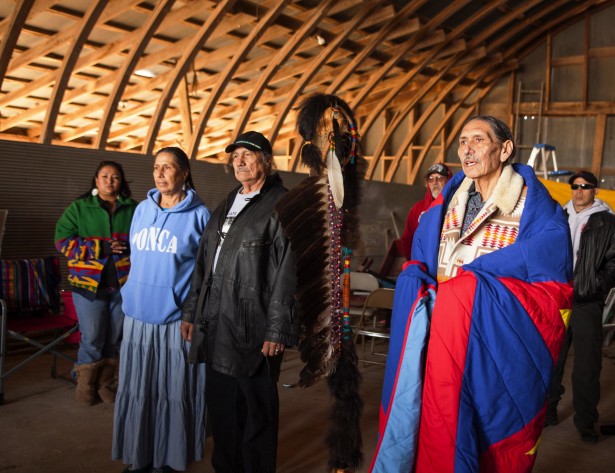 Indigenous resistance grows strong in Keystone XL battle
Braun volunteered with Owe Aku International Justice Project, an organization founded by Lakota activist Debra White Feather that defends Indigenous sovereignty and was instrumental in the Keystone Xl fight. In 2013-2014, Owe Aku organized a series of irenic direct action trainings along the Keystone XL route, in anticipation of construction on the northern leg. The events included skills workshops, traditional teachings, and spiritual preparation for the fight alee. "It was exhausting but uplifting," Braun said. "We were meeting and finding our voice."
White Feather was experienced with directly activeness, having joined the 1973 American Indian Movement occupation of Wounded Knee. She, Braun and other leaders knew their work was unsafe. For some Indigenous grooming participants, the idea of engaging in forceful protest took some getting used to. "We had been conditioned for and so long not to practice that sort of thing because it would draw attention to us," Braun said. "Nosotros'd had to avoid conflict to survive as a people. But sometimes those tactics are necessary." She watched as tribal elders prepared to thrust themselves into the spotlight protesting the pipeline. "It was both scary and liberating."
The immediate threat from Keystone XL receded when, after years of indecision, Obama finally rejected the northern leg in November 2015. Never before had a U.Southward. president stopped a major piece of oil infrastructure due to climate concerns. Withal, Braun and others were soon taking straight action to cease a different project: the Dakota Admission pipeline.
The proposed route for Dakota Access skirted the Standing Rock Sioux Reservation, which shares a border with the Cheyenne River Reservation to the s. Although not primarily a tar sands pipeline, Dakota Access connected to another center of fossil fuel expansion: North Dakota's Bakken oil fields. It cut under the Missouri River, jeopardizing Standing Stone's water supply.
"We got a call from Standing Rock asking for help," Braun said. "I reached out to our Cheyenne River youth who'd been preparation for Keystone Forty, and asked if they were fix to fight some other pipeline? They said yes."
Previous Coverage
 How #NoDAPL united a move for indigenous rights
Braun was among the offset to arrive at Continuing Stone in April 2016, every bit locals prepared to set up encampments in the pipeline's path. Over the next few months, thousands of Indigenous people and non-Ethnic supporters from around the continent converged there for the largest protest of its kind in modernistic U.S. history. Police force used chemical weapons, water cannons and set on dogs on protesters; Braun sustained permanent lung damage she attributes to the chemicals. Even so, the encampments also proved amazingly successful. In Dec 2016, the outgoing Obama assistants reversed an Regular army Corps of Engineers let for Dakota Access, stopping construction.
The victory was brusk-lived, every bit one of the new Trump assistants's showtime acts was to re-approve Dakota Access and invite TC Free energy to re-submit its Keystone XL application. But Continuing Stone showed how years of preparation to resist Keystone Twoscore had galvanized a larger moving ridge of opposition to oil. "Keystone 40 taught u.s. a lot most how to build alliances and fight pipelines," Braun said. "We could apply all that for other fights."
A mass movement
In Feb 2013, an estimated 50,000 people converged on the National Mall for the Forward on Climate rally, one of the largest demonstrations against Keystone Twoscore. In 2017, Nebraska ranchers installed solar panels in the pipeline's path. At that place were protests and acts of civil disobedience against Keystone Twoscore from coast to declension. Such a huge effort required a diverse coalition of activist groups, but relationships between them weren't ever without tension. "We definitely argued," Braun said. "At that place were lots of tears. For example, nosotros faced a lot of white privilege and racism dealing with our non-Native peers."
Previous Coverage
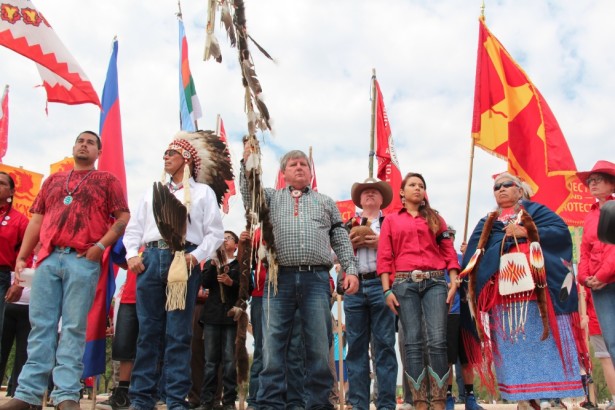 When Cowboys and Indians unite — Inside the unlikely alliance that is remaking the climate motility
So at that place was the battle for the narrative around the pipeline's southern leg. "The large NGOs portray the Keystone Forty entrada as a complete victory won in D.C.," Cindy Spoon said. "Their priorities were having large rallies and marches there, where grassroots people don't take a lot of power, instead of having those same things along the pipeline route in Oklahoma or Texas."
Yet, with all its internal disagreements and conflicts over very real systemic issues, the Keystone XL campaign helped energize a wider movement to stop pipelines and other fossil fuel infrastructure — from coal mines in Montana to fracking projects in New England. For organizers of some of the most iconic tar sands protests, this was a goal from the offset. "Our promise was the Tar Sands Action would inspire people, capture their imaginations, and they'd take that inspiration back to climate fights in their communities," Matt Leonard said.
Nearly significant of all was the Ethnic movement that united around Keystone XL and accomplished its most visible expression at the Standing Rock encampments. From the Texas Trans-Pecos pipeline to the Bayou Span pipeline in Louisiana to the Line 3 tar sands pipeline in Minnesota, oil projects all over the U.South. faced Indigenous-led direct activity campaigns in the years later on Continuing Rock.
All the while, climate activists and Indigenous groups kept ane middle on Keystone XL. A May 2020 court ruling blocked TC Free energy from building parts of the pipeline across streams. Even so, the company began piece of work on other sections last twelvemonth, when COVID-19 made large protests difficult to plan.
Groups like the Indigenous youth-led Cheyenne River Grassroots Collective sprang into action, despite challenges posed by the virus. On Nov. 21, Jasilyn Charger of the Cheyenne River Sioux was arrested subsequently locking herself to a pump station along the pipeline road. It was a straw of the larger scale direct action to come if structure began in earnest. Organizations like 350.org stood by, ready to aid if and when Indigenous leaders put out the phone call for a Standing Rock-style mobilization.
Things never got to that point, though. On mean solar day one of his assistants, President Biden rescinded Keystone XL'due south let, halting all work on the project.

Support The states
Waging Nonviolence depends on your support. Become a sustaining member today and receive a souvenir of your option.
Support
Moving forward
The fight confronting Keystone Xl may be over for now, just for the movement that came together to end it the work of pressuring the Biden administration has only begun. "We can't back off," Leonard said. "Biden is certainly not Trump, but he'due south no climate justice champion. It'due south going to have existent grassroots pressure to move him on other issues."
Also stopping Keystone XL, Biden's early climate actions include freezing new fossil fuel leases on public lands and restarting pollution regulations. Simply he has non overturned permits for other major pipelines, despite having options to exercise so. On Tuesday, a circuit court upheld a decision voiding the Army Corps of Engineers' approval of Dakota Access. Biden could require that the pipeline shut downward while the Corps writes a new environmental impact statement. He could also revoke the permit for Line 3, now under structure. "To be the climate president he claims to be, Biden needs to finish these pipelines as well," Braun said.
Previous Coverage
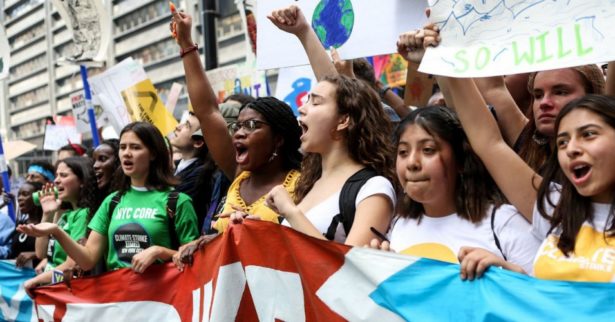 How Generation Z is leading the climate move
Climate activists lost no time mobilizing in the administration'south early on days. "Nosotros desire to create a political atmosphere that says climatic change is happening and nosotros need to act," said Shiva Rajbhandari of Extinction Rebellion Youth Boise, which organized an Inauguration Day banner driblet at Idaho's State Capitol. The following mean solar day, the youth-led Sunrise Movement held like actions all over the state. "Biden and other Democrats could not take won without the huge cake of Gen Z voters who care most climate," Rajbhandari said. "Now nosotros're holding these politicians accountable."
Also of import is making certain Keystone 40 never resurfaces. "I call information technology the zombie pipeline," Braun said. "I believe this is the smash in the coffin, just we accept to be vigilant. A future president could bring Keystone XL back unless we cease it permanently through legislation or the courts." Groups like Ethnic Environmental Network are pursuing this long-term objective.
From organizing in communities on the frontlines of extraction to large national mobilizations to sustained directly action in places like Texas and the Cheyenne River Reservation, opposition to Keystone XL tested strategies climate groups will likely need in many other campaigns to come. The election of Joe Biden has opened the door to new opportunities — simply information technology doesn't mean activists can rest.
"I recall Biden rightly realizes the climate motion has get a powerful force in politics," Leonard said. "Keystone 40's defeat is ane of the nearly visible symbols of that. Now we need to push button forward with more fights like it."
Source: https://wagingnonviolence.org/2021/01/keystone-xl-tar-sands-pipeline-defeated-climate-movement/
Posted by: gilpinaftente1958.blogspot.com
0 Response to "What Is The Makeup Of The Protesters Against The Keystone Pipeline"
Post a Comment